The Essential Role of Cinema Icons in Modern Design
Cinema is more than just a form of entertainment; it’s a vast visual language. It communicates stories, emotions, and ideas through a combination of imagery, sound, and movement. For designers and creators, capturing the essence of this visual language in digital interfaces is a common challenge. This is where a specialized set of Cinema icons becomes a powerful tool. Instead of describing complex concepts with lengthy text, these icons allow you to represent film-related ideas instantly and aesthetically.
What Makes Cinema Icons So Practical?
A well-designed Cinema icon set serves a clear main purpose: to provide universally recognizable symbols for anything related to film, video, and media. Their characteristics are rooted in simplicity and clarity. Using a line icon style, for instance, means the icons are created with clean strokes and open shapes, which makes them modern, scalable, and easy to integrate into various designs. Their value lies in saving time, ensuring visual consistency, and enhancing user understanding.
Their appeal is broad. A casual user might appreciate their clean look on a personal blog reviewing movies, while a professional app developer needs them to build an intuitive media player interface. They solve the problem of visual communication, supporting goals like improving user experience, speeding up project workflows, and adding a polished, thematic touch to any design.
Real-World Uses for a Cinema Icon Collection
Consider how these icons function across different contexts. An educator creating a presentation on film history can use a film reel icon to denote classic cinema or a clapperboard icon to introduce sections about production. A marketer designing an infographic for a streaming service’s annual report can utilize play, pause, and download icons to represent user engagement statistics clearly.
For digital and commercial applications, the uses are extensive:
- Mobile Apps: Navigation icons for video library apps, buttons for media controls, or feature indicators for subscription tiers.
- Website Templates: Service icons for a videographer’s portfolio, call-to-action symbols for a film festival site, or decorative elements for a cinema blog.
- User Interface Design: Functional elements in editing software dashboards, status indicators in video uploading platforms, or settings icons in media players.
Each icon, like a director’s chair or a ticket stub, becomes a visual shorthand that users understand immediately, reducing cognitive load and making interfaces more friendly.
Key Features and File Formats for Flexibility
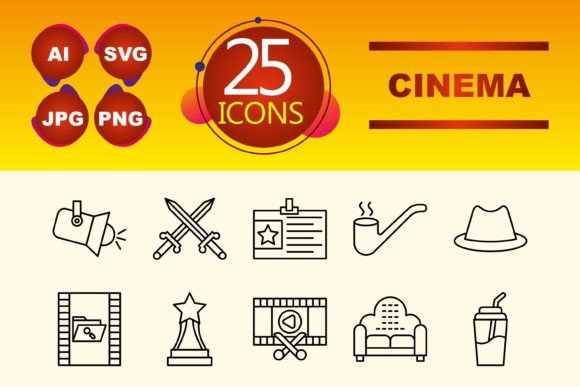
A focused set of 10 Cinema icons in a line style offers a curated toolkit. It’s not overwhelming, covering essential concepts without bloat. The inclusion of multiple file types—AI, JPG, PNG, and SVG—is what makes it genuinely versatile.
This is an important consideration for users at all levels. The AI file allows professionals to edit and customize the icons vectorially in Adobe Illustrator. The SVG format is perfect for web and app development, offering scalable graphics without quality loss. PNG and JPG files are ready-to-use for beginners in presentations, social media graphics, or simple document insertion. Having all these formats means you can start using the icons in your current project, regardless of your software expertise or the final output medium.
Choosing the Right Icons for Your Project
Before integrating any Cinema icon set, think about your specific needs. Are you building a functional interface where clarity is paramount? The line style’s minimalism excels here. Is your project more decorative, like a themed website? The same icons can add cohesive stylistic accents. Also, consider audience familiarity; icons like a “video camera” are globally understood, while a more specific “film slate” icon might be perfect for an industry-specific audience.
Look at the scope of the set. Ten icons covering fundamental Cinema concepts—think action, playback, production, and viewing—can be sufficient for many projects, allowing you to maintain a consistent visual theme without searching for disparate assets. It’s a practical observation that a small, high-quality set often yields better results than a large collection of mismatched styles.
Integrating Cinema Icons into Your Creative Workflow
For freelancers, small business owners, and hobbyists, these icons can streamline creation. Imagine you’re a blogger. You can quickly add a relevant Cinema icon to your post headers to visually categorize content about movie reviews versus filmmaking tutorials. An entrepreneur launching a podcast about cinema might use these icons in the podcast’s website UI to differentiate episodes about directing, cinematography, and screenwriting.
In educational contexts, they serve as visual aids. A teacher can embed them into digital learning modules to break up text and signal different activity types—a “star” icon for a critical analysis task, or a “speaker” icon for a lecture on film sound. This makes the material more engaging and easier to navigate for students.
The natural use of Cinema icons extends into lifestyle and business. A community arts center’s event calendar can use a “ticket” icon to highlight film screenings. A corporate training department creating an internal course on media literacy can use these icons to design a cleaner, more memorable slide deck.
Ultimately, a dedicated Cinema icon set is a bridge between the rich world of film and the clean demands of digital design. By providing simple, versatile symbols, it helps creators across fields communicate film-related ideas effectively, making their projects more intuitive, visually cohesive, and professionally polished. Whether you’re a beginner adding a touch of theme to a presentation or a professional building a complex app interface, these icons offer a fundamental design solution grounded in the universal language of Cinema.