The Essential Visual Language of Marketing Technology
In today's digitally-driven marketplace, Marketing Technology—often called Martech—is no longer a niche discipline but the central nervous system of modern business growth. It encompasses the vast array of tools, platforms, and software that marketers use to plan, execute, measure, and optimize their campaigns across channels. From email automation and social media management to sophisticated analytics and customer data platforms, Marketing Technology enables precision, personalization, and scale. Its relevance is absolute; without it, businesses cannot effectively reach, understand, or engage their audiences in a fragmented digital landscape.
The Evolution from Toolboxes to Ecosystems
The journey of Marketing Technology has been one of rapid consolidation and integration. Early iterations involved disparate, standalone tools—a separate platform for email, another for social posting, a different system for analytics. Today, the focus is on interconnected ecosystems. Professionals seek platforms that speak to each other, creating a seamless flow of data and action. This shift reflects a broader change in workflow: marketing is now a continuous, data-informed loop rather than a series of isolated campaigns. The modern marketer's dashboard is a command center, and clarity within that interface is paramount.
This is where the role of visual design, specifically iconography, becomes critically practical. In a complex software environment, clear, intuitive symbols guide the user, reduce cognitive load, and accelerate mastery. A well-designed set of Marketing Technology icons acts as a universal shorthand, instantly conveying functions like "audience segmentation," "campaign analytics," or "content scheduling." For the professional navigating a dense platform, these visual cues are not mere decoration; they are essential navigational aids that enhance efficiency and reduce error.
Iconography as a Bridge in User Interface Design
For creators—the designers and developers building the tools, templates, and applications that marketers use—providing this clear visual language is a key responsibility. A specialized set of Marketing Technology relative icons serves as a direct bridge between complex functionality and user understanding. Consider a mobile app designed for on-the-go social media management. Screen real estate is limited. A concise line icon representing "engagement metrics" communicates instantly, saving space and text. Similarly, in website templates for marketing agencies or SaaS companies, these icons can visually segment services, making offerings like "automation" or "lead tracking" immediately graspable to potential clients.
The stylistic choice of line icons is particularly suited to contemporary digital aesthetics. Their clean, minimalist form ensures they remain legible at various sizes and don't compete with content for attention. They feel modern, professional, and tech-forward, aligning perfectly with the sleek interfaces of most Marketing Technology platforms. When used in presentations or infographics, these icons transform dense data and processes into accessible visual stories. A flowchart explaining a customer journey, punctuated with recognizable Martech icons for "touchpoint" or "conversion," becomes far more engaging and memorable for stakeholders, educators, or team members.
Practical Implications for Diverse Users
The utility of a dedicated icon set extends across the spectrum of our audience. For the entrepreneur building a new brand, using these icons in a pitch deck can help articulate a sophisticated marketing tech stack visually, fostering investor confidence. For the freelancer or consultant, incorporating them into proposal documents or project plans adds a layer of professional clarity. Bloggers and educators can use them to illustrate articles or course materials about marketing technology trends, making abstract concepts tangible.
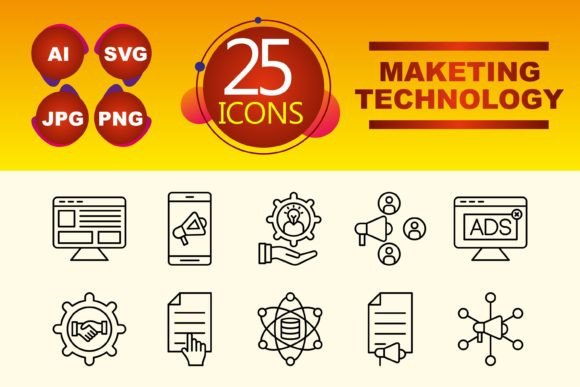
The technical specifications of a set—such as featuring 10 core icons in multiple file formats like AI, JPG, PNG, and SVG—address real-world creative needs. SVG files ensure scalability and crispness in web and app interfaces. PNG and JPG files offer ready-to-use raster formats for presentations or quick graphics. The inclusion of AI files provides the source for designers who need to adapt, recolor, or integrate the icons into larger brand systems. This multi-format approach empowers users to implement the assets directly into their workflow without unnecessary conversion hurdles.
Aligning with Modern Market Preferences
Current trends in business communication and consumer expectation lean heavily towards visual speed and clarity. People, especially professionals pressed for time, prefer to absorb information quickly. Charts, diagrams, and well-designed interfaces are favored over monolithic text blocks. A set of Marketing Technology icons taps directly into this preference. When a business owner visits a website for a new analytics tool and sees a familiar icon for "data dashboard," their understanding is instantaneous. This alignment reduces friction in adoption and learning.
Furthermore, the consolidation of marketing roles means individuals often manage multiple tech responsibilities. The visual consistency provided by a unified icon set across different materials—from internal training docs to client-facing app interfaces—creates a cohesive brand and user experience. It signals a thoughtful, designed approach to the complex world of Marketing Technology.
Realistic Applications and Recommendations
Consider a practical example: a mid-sized company is rolling out a new internal platform to train its sales team on marketing lead tools. The training module's interface, built from a website template, uses line icons to denote different sections: a funnel icon for lead stages, a message icon for communication tools, and a graph icon for performance tracking. This visual guide helps new users navigate the platform more confidently.
For creators looking to implement such icons, the recommendation is to focus on contextual relevance. Use the icons to label, not just decorate. In a mobile app, pair them with clear text labels for ultimate accessibility. In an infographic, use them as consistent visual anchors for each key point about the marketing technology process. Avoid overuse; the power of 10 carefully chosen icons lies in their focused representation of core Martech concepts—like automation, analytics, content, social, email, SEO, CRM, advertising, data, and integration.
The attention paid to Marketing Technology iconography reflects its matured place in the business world. It is recognized not just as a stack of tools, but as a complete operational environment that requires its own clear visual dialect. By investing in this dialect—through purposeful design and implementation—professionals, creators, and businesses can communicate more effectively, build better tools, and ultimately harness the true power of their Marketing Technology with greater ease and precision.