Beyond Flat Graphics: How Business 3D Icons Are Redefining Professional Visual Communication
In the constantly evolving landscape of professional design and marketing, the tools we use to communicate ideas must evolve just as rapidly. The shift from flat, two-dimensional graphics to richer, more immersive visual elements is a significant trend, driven by a demand for depth, flexibility, and modern aesthetic appeal. At the forefront of this shift for business applications is the adoption of high-quality Business 3D Icons. These are not mere illustrations; they are versatile, scalable three-dimensional assets designed to elevate projects across print, web, digital applications, and beyond.
The Evolution of Visual Assets in a Depth-Oriented Digital World
The digital environment has become increasingly three-dimensional. From website interfaces that employ subtle shadows and layers to mobile apps with tactile-looking buttons, and presentations that aim for a cinematic feel, the expectation for visual depth is now commonplace. This is part of a broader trend where users and audiences seek more engaging, realistic, and interactive experiences. Flat icon sets, while clean and functional, often lack the dynamism required to stand out in this context. Business 3D Icons directly address this gap by providing objects with volume, perspective, and materiality.
This trend aligns with advancements in technology and software accessibility. Tools like Blender, a powerful open-source 3D suite, have become mainstream, enabling more creators to work with 3D assets without prohibitive costs. The availability of ready-to-use 3D files, such as those included in a comprehensive Business 3D Icons set, democratizes high-end visual design, allowing marketers, entrepreneurs, and freelancers to produce work that rivals that of specialized studios.
Why Professional Attention is Focused on 3D Iconography
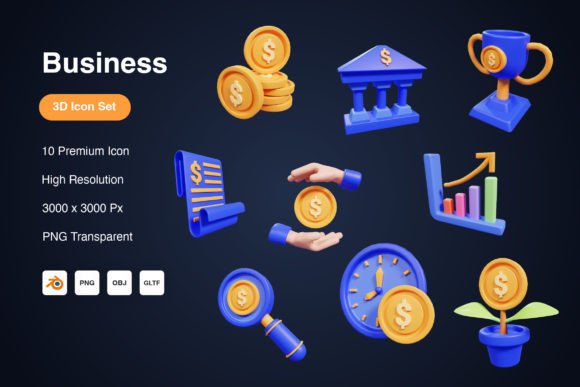
Professionals are paying attention to Business 3D Icons because they solve multiple contemporary challenges simultaneously. First, they offer unmatched versatility. An icon rendered in 3D can be adapted for a multitude of outputs—from a sleek symbol on a mobile app interface to a striking graphic on a physical brochure—without losing its core identity. The provided file formats, including PNG with transparent backgrounds for immediate use and OBJ or GLTF for 3D editing, cater to this multi-platform necessity.
Second, they fulfill the growing need for brand cohesion across mediums. A company can use the same set of 3D icons in its webinar presentation, its annual report infographic, and its product website, ensuring a consistent and modern visual language that strengthens brand recognition. The ability to easily change color and texture within Blender, as noted in premium sets, means these icons can be tailored to match exact brand palettes and material styles, moving beyond static, unchangeable graphics.
Changing Workflows and the Demand for Adaptive Design Elements
The workflows of creators and business teams have changed dramatically. Agility and iteration are key; a design asset must be flexible enough to undergo rapid changes based on feedback, platform requirements, or new campaign directions. A traditional 2D icon, once created, is largely fixed. A 3D icon, however, especially one provided with a native Blender file, is inherently malleable. Its color, finish (matte, glossy, metallic), and even lighting can be adjusted without starting from scratch. This aligns perfectly with modern, iterative design processes and rapid prototyping needs in marketing and product development.
Furthermore, the expectation for premium quality at accessible scales has risen. Clients and internal stakeholders now expect graphics to look polished and professional regardless of the project's budget or timeline. A set of premium Business 3D Icons, rendered at 3000x3000 px resolution, ensures crisp, detailed output even for large-format prints like banners or high-DPI screens. This removes a technical hurdle and allows professionals to focus on composition and message rather than asset quality concerns.
Practical Applications: Integrating 3D Icons into Real-World Projects
The practical utility of a well-crafted Business 3D Icons set is best understood through examples. Consider a financial consultancy creating an investor presentation. Using 3D icons of graphs, buildings, and coins adds a tangible, substantial feel to abstract data, making concepts more relatable. For a tech startup developing an app, 3D icons for its interface can provide a sense of innovation and interactivity, enhancing user perception.
In marketing campaigns, these icons become key visual components. A social media banner featuring a 3D icon of a product or service symbol instantly grabs more attention than a flat alternative. A postcard or greeting card with a three-dimensional celebratory icon feels more engaging and festive. Even in internal projects, like a process infographic for employee training, 3D icons can make steps and tools appear more concrete and easier to understand.
- Presentation Slides: Transform dense information into memorable visual points.
- Website & App Symbols: Elevate UI/UX with icons that suggest functionality and quality.
- Print Collateral: Ensure brochures and reports stand out with contemporary graphics.
- Infographic Elements: Add clarity and visual appeal to complex data storytelling.
- Branded Marketing Materials: Maintain consistency and premium feel across all touchpoints.
Connecting to Larger Developments: The Future of Visual Tools
The relevance of Business 3D Icons is deeply connected to larger developments in how we create and consume information. The rise of augmented reality (AR) and virtual environments in business contexts—for product demos, virtual tours, or training simulations—points towards a future where 3D assets are the baseline, not the exception. Having a library of editable 3D business icons prepares organizations for this gradual shift, making future transitions into more immersive media smoother.
Moreover, the ongoing blending of design disciplines means that professionals are no longer confined to one medium. A marketer might need to assemble a video, a web page, and a printed booklet for a single campaign. Assets that are inherently multi-format, like a 3D icon set that provides both rendered PNGs and editable 3D files, empower this cross-disciplinary work. They represent a move towards unified asset libraries that serve diverse creative needs, reducing friction and resource duplication.
Conclusion: Embracing Depth as a Standard for Professional Communication
The adoption of Business 3D Icons is more than a stylistic choice; it is a practical response to the evolving demands of professional communication. As audiences expect more sophisticated and engaging visuals, and as creators require more flexible and powerful tools, these three-dimensional assets provide an essential solution. By offering premium quality, effortless adaptability across countless projects, and seamless integration into modern workflows and future trends, they represent a significant upgrade from traditional graphic libraries. For professionals, creators, and businesses aiming to communicate with impact and coherence in today's depth-oriented world, integrating such versatile 3D iconography is becoming an insightful and necessary step.